Lecture 02.2: Agent Programs and Representations
Understanding the different types of agent programs, from simple reflex to learning agents, and how states are represented.
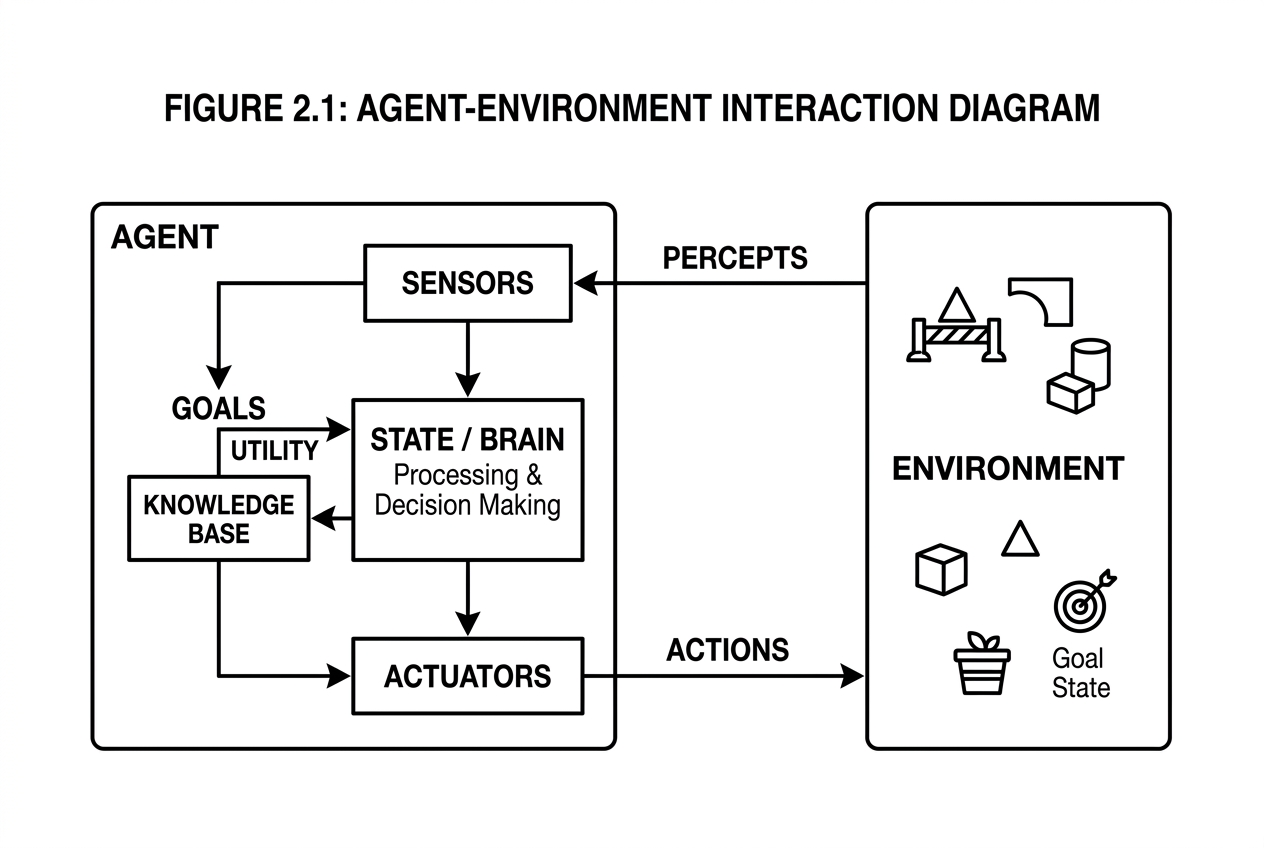
Agent Program Types
An agent is comprised of an architecture and a program. The agent program runs on the physical architecture to produce the agent function f.
There are four basic types of agent programs (along with a fifth overarching type):
1. Simple Reflex Agents
These agents select actions based purely on the current percept, ignoring the rest of the percept history.
They use condition-action rules (also known as situation-action rules, productions, or if-then rules), e.g., if car-in-front-is-braking then initiate-braking.
Vacuum-Cleaner Reflex Agent Pseudocode
function Reflex-Vacuum-Agent([location, status]) returns an action
    if status == Dirty then return Clean
    else if location == A then return Right
else if location == B then return Left- Limitations & Partial Observability: Simple reflex agents succeed only if the environment is fully observable. If sensors fail (e.g., location sensor is off), the agent can get trapped in infinite loops.
- Randomization: Injecting randomized actions can help simple reflex agents escape infinite loops in partially observable environments and achieve rational behavior.
2. Model-Based Reflex Agents
This is the most effective way to handle partial observability. The agent keeps track of the part of the world it cannot currently see. It maintains an internal state that depends on the percept history. Updating this state requires two kinds of knowledge:
- Transition Model: How the world evolves independently of the agent.
- Sensor Model: How the agent's percepts derive from the state of the world.
Model-Based Reflex Agent Pseudocode
function Reflex-Agent-With-State(percept) returns an action
    persistent: state (description of current world),
                rules (set of condition-action rules),
                action (most recent action, initially none)

    state  ← Update-State(state, action, percept)
    rule   ← Rule-Match(state, rules)
    action ← Rule-Action(rule)
    return action
3. Goal-Based Agents
Knowing the current state of the environment is not always enough. For example, at a road junction, knowing you are at a junction doesn't tell you which way to turn. These agents need goals—information that describes desirable situations. They use planning and search to predict the future and choose actions that achieve the goal.
4. Utility-Based Agents
Goals alone only provide a binary "happy" or "unhappy" state. Often, there are multiple ways to achieve a goal, but some are quicker, safer, or cheaper. A utility function maps a state onto a real number, describing the associated degree of happiness. These agents act to maximize their expected utility.
5. Learning Agents
All the agents described above can be built as learning agents. A learning agent consists of several components:
- Learning Element: Responsible for making improvements to the agent's performance.
- Performance Element: Responsible for selecting external actions based on percepts (the traditional agent core, acting on rewards vs. penalties—e.g., getting a tip vs. no tip for a taxi driver).
- Critic: Provides feedback on how well the agent is doing against a fixed performance standard.
- Problem Generator: Suggests new exploratory actions to discover better strategies rather than just exploiting known ones. Specifically:
- Sets learning goals.
- Generates hypothetical scenarios or new experiences.
- Promotes exploration over exploitation.
Agent Characterisation and Goals
An agent is responsible for satisfying specific goals. These goals can be categorized into four types:
- 1. Achieving an exactly defined status: Reaching a specific final target state (e.g., exact target stack of blocks).
- 2. Achieving constrained status: Reaching a state that satisfies a rule (e.g., "the smallest block is on top"). Unlike exact goals, constrained goals allow multiple valid target states (e.g., small on top of medium on top of large, OR small on top of large on top of medium).
- 3. Continuously keeping an instable status: Maintaining an unstable physical or dynamical state in equilibrium continuously over time.
- 4. Maximizing utility: E.g., filling a basket with mushrooms that can be sold for the maximum possible price.
The state of an agent includes its internal environment plus its knowledge and beliefs about its external environment.
How Components of Agent Programs Work (Representations)
To perform complex reasoning, agents need to represent the state of the world internally. There is an axis of increasing expressiveness in representation: Atomic → Factored → Structured.
1. Atomic Representation
The state is a "black box" with no internal structure.
- Example: In a route-finding algorithm, cities are treated as atomic states identifiable only by their name.
- Usage: Standard search algorithms, game-playing, Hidden Markov Models (HMMs), and Markov Decision Processes (MDPs).
2. Factored Representation
Each state is split into a set of variables or attributes.
- Example: A driving problem includes variables like GPS coordinates, gas tank level, oil warning light status, available money for tolls, and radio station playing.
- Advantage: Sharing attributes makes transitions between factored states much easier to compute.
- Usage: Constraint satisfaction, propositional logic, planning algorithms, Bayesian networks, and machine learning.
3. Structured Representation
The world is understood as having objects with relationships. It goes beyond simple variables and values to describe dynamic interactions.
- Example: Observing a complex situation like "a truck reversing into a driveway, blocked by a loose cow."
- Usage: Relational databases, first-order logic, first-order probability models, and natural language understanding (reflecting human expression about objects and interactions).
Expressiveness Comparison (Chess Rules Example)
More expressive representations can capture everything less expressive ones can, but in a much more concise form:
| Representation Level | Specification of Chess Rules | Reasoning / Learning Complexity |
|---|---|---|
| Structured (First-Order Logic) | 1–2 pages | Highly expressive; complex reasoning |
| Factored (Propositional Logic) | Thousands of pages | Medium expressiveness & complexity |
| Atomic (Finite-State Automata) | pages | Least expressive; simple black-box matching |
Trade-off: Higher expressiveness allows for dramatically more concise descriptions but requires more complex reasoning and learning algorithms.
Localist vs. Distributed Representation (Concept-to-Memory)
When dealing with memory models (especially neural networks):
- Localist: Each concept is stored in a single, unique memory location (one-to-one mapping). It is simple but not robust to noise; if one unit fails, the entire concept is lost (e.g., accidentally confusing "Truck" with "Truce" if a single memory unit is corrupted).
- Distributed: A concept is represented across many memory locations, and each location contributes to multiple concepts. It is robust—even if some units are corrupted, the concept can still be approximately recovered.
Lecture 02.1: Intelligent Agents and Environments
Exploring the nature of intelligent agents, percept sequences, the PEAS framework, and different types of environments.
Lecture 03.1: Problem Solving and Search Formulation
Introduction to problem-solving agents, goal formulation, state spaces, formal problem definitions, abstraction, and the 8-Queens problem.