Lecture 02.1: Intelligent Agents and Environments
Exploring the nature of intelligent agents, percept sequences, the PEAS framework, and different types of environments.
What is an Agent?
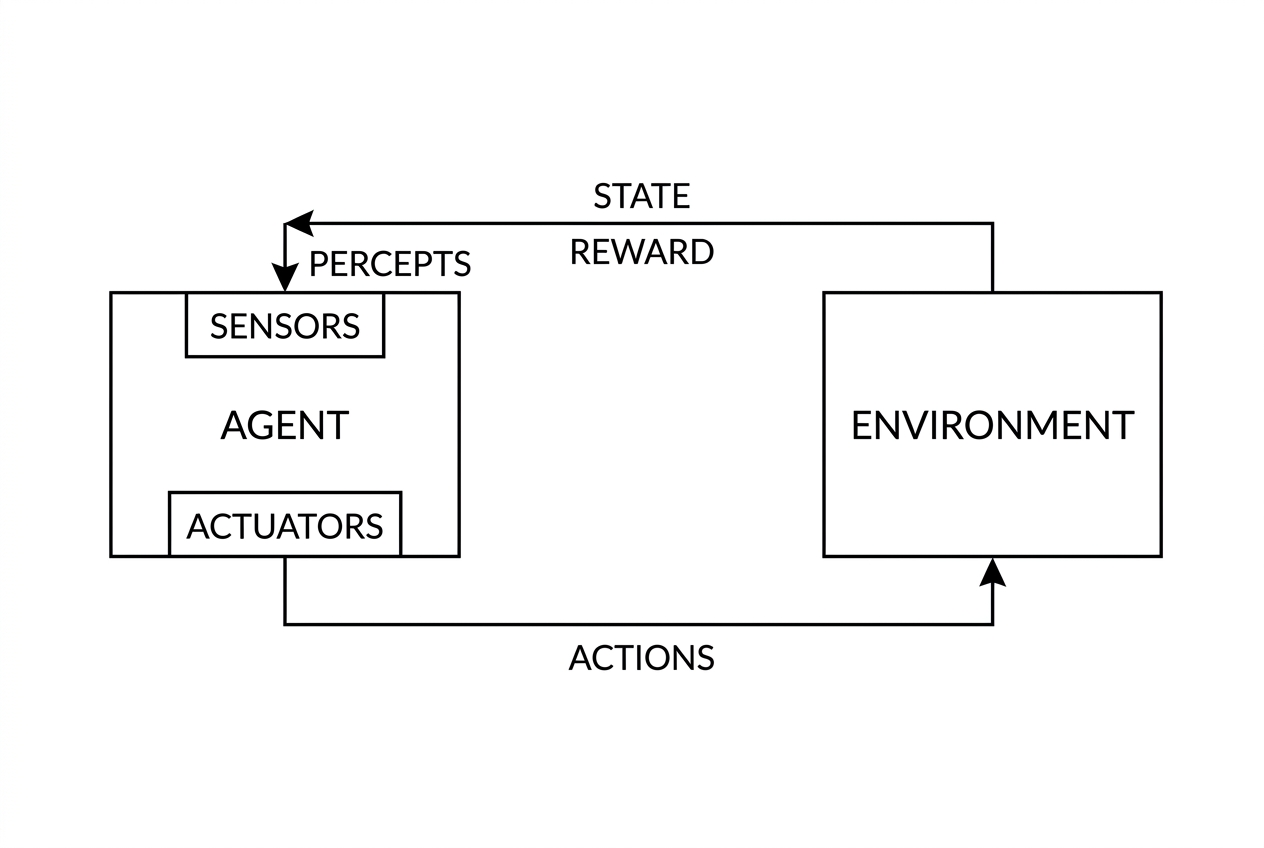
An agent is anything that can be viewed as perceiving its environment through sensors and acting upon that environment through actuators.
- Human Agent: Sensors include eyes and ears. Actuators include hands, legs, and mouth.
- Robotic Agent: Sensors include cameras, touch sensors, and infrared range finders. Actuators include motors.
- Software Agent: Sensors receive keystrokes, file contents, and network packets. Actuators display on the screen, write to files, and send network packets.
Agents & Environments
The agent takes sensory input from its environment and produces output actions that affect it.
- Percept: The term used to refer to the content an agent's sensors are perceiving.
- Percept Sequence: The complete history of everything the agent has ever perceived.
An agent's behavior is described by the agent function, which maps any given percept sequence to an action: [f: P* → A].
The agent program runs on the physical architecture (computing device) to produce this function.
Agent = Architecture + Program
What makes an Agent "Intelligent" or "Rational"?
A rational agent is one that acts so as to achieve the best outcome, or when there is uncertainty, the best expected outcome.
What is rational at any given time depends on four things:
- The performance measure that defines the criterion of success.
- The agent's prior knowledge of the environment.
- The actions that the agent can perform.
- The agent's percept sequence to date.
For example, the performance measure of a vacuum-cleaner agent could be the amount of dirt cleaned up, time taken, electricity consumed, or noise generated.
An intelligent agent is capable of flexible autonomous action. According to Wooldridge & Jennings, "flexible" means three things:
- Reactivity: Agents perceive their environment and respond in a timely fashion.
- Pro-activeness: Agents exhibit goal-directed behavior by taking the initiative.
- Social ability: Agents are capable of interacting with other agents or humans.
Furthermore, an agent is autonomous if its behavior is determined by its own experience (the ability to learn and adapt).
Task Environment (PEAS)
When designing an intelligent agent, we must first specify the setting. We use the PEAS description:
- Performance measure
- Environment
- Actuators
- Sensors
PEAS Examples
- Automated Taxi Driver:
- Performance: Safe, fast, legal, comfortable trip, maximize profits, minimize impact on other road users.
- Environment: Roads, other traffic, police, pedestrians, customers, weather.
- Actuators: Steering, accelerator, brake, signal, horn, display, speech.
- Sensors: Cameras, radar, speedometer, GPS, engine sensors, accelerometer, microphones, touchscreen.
- Medical Diagnosis System:
- Performance: Healthy patient, minimize costs, fewer lawsuits.
- Environment: Patient, hospital, staff.
- Actuators: Screen display (questions, tests, diagnoses, treatments, referrals).
- Sensors: Keyboard entry of symptoms, findings, patient's answers.
- Part-Picking Robot:
- Performance: Percentage of parts in correct bins.
- Environment: Conveyor belt with parts, bins.
- Actuators: Jointed arm and hand.
- Sensors: Camera, joint angle sensors.
- Proposal Writing Agent (Research & Drafting):
- Performance: High-quality output, timely submission.
- Environment: Open web, APIs, documents.
- Actuators: Text generation, web search, scheduling APIs.
- Sensors: User queries, retrieved documents, calendar status.
Environment Types
Environments can vary drastically in their characteristics, which influences the agent design:
- Fully Observable vs. Partially Observable: Does the agent's sensors give it access to the complete state of the environment at all times?
- Deterministic vs. Stochastic: Is the next state of the environment completely determined by the current state and the agent's action?
- Episodic vs. Sequential: Is the agent's experience divided into atomic "episodes" that do not depend on past actions?
- Static vs. Dynamic: Can the environment change while the agent is deliberating? (If only the agent's performance score changes, it is semidynamic).
- Discrete vs. Continuous: Are there a limited number of distinct percepts and actions?
- Single Agent vs. Multiagent: Is the agent operating by itself or alongside others? (e.g. Crossword puzzle vs. Chess).
Task Environment Characteristics Matrix
The table below summarizes the characteristics of several classic task environments across all six properties:
| Task Environment | Observable | Agents | Deterministic | Episodic | Static | Discrete |
|---|---|---|---|---|---|---|
| Crossword puzzle | Fully | Single | Deterministic | Sequential | Static | Discrete |
| Chess with a clock | Fully | Multi | Deterministic | Sequential | Semi | Discrete |
| Poker | Partially | Multi | Stochastic | Sequential | Static | Discrete |
| Backgammon | Fully | Multi | Stochastic | Sequential | Static | Discrete |
| Taxi driving | Partially | Multi | Stochastic | Sequential | Dynamic | Continuous |
| Medical diagnosis | Partially | Single | Stochastic | Sequential | Dynamic | Continuous |
| Image analysis | Fully | Single | Deterministic | Episodic | Semi | Continuous |
| Part-picking robot | Partially | Single | Stochastic | Episodic | Dynamic | Continuous |
| Refinery controller | Partially | Single | Stochastic | Sequential | Dynamic | Continuous |
| English tutor | Partially | Multi | Stochastic | Sequential | Dynamic | Discrete |
Lecture 01: Overview of Artificial Intelligence
A comprehensive overview of Artificial Intelligence, intelligence definitions, core agent philosophies, historical milestones, and modern state of the art.
Lecture 02.2: Agent Programs and Representations
Understanding the different types of agent programs, from simple reflex to learning agents, and how states are represented.